


Anastasia Sternberg
  • anastasia.uxr@proton.me
  • linkedin.com/in/ana1
  • github.com/Madame-UX
  • kogniolabs.com
Anastasia Sternberg portrait

Human Factors Engineering

Human factors work on devices and systems where use error carries clinical and operational risk.

Formative usability evaluation, use-related risk analysis, and regulatory-facing HFE documentation across FDA-regulated medical devices and FAA/EASA aviation systems, structured to IEC 62366-1, ISO 14971, AAMI HE75, and FDA HFE guidance.

01About

My work sits at the intersection of human behavior and system risk. In regulated environments, usability is not a design preference; it is a control against foreseeable use error. I trace where human-system interaction creates error probability, document it, and translate findings into design decisions that hold up in 510(k) submissions and summative validation.

My background spans surgical robotics, interventional ablation systems, electronic flight bags, and statewide clinical software rollouts. Across these domains the discipline is the same: structured risk analysis, task-based evaluation under realistic conditions, and deliverables that give engineering and regulatory teams something actionable.

I carry IEC 62366-1, ISO 14971, AAMI HE75, and FDA HFE Guidance fluency into every engagement. Through Kognio Labs, I bring the same standard to contract work for medical device and SaMD clients navigating pre-market submissions.

I build interactive research prototypes, web apps and SaMD concepts, for formative testing and stakeholder validation.

Professional affiliations

Human Factors and Ergonomics Society (HFES)Association for the Advancement of Medical Instrumentation (AAMI)
02Methods & Skills

Methods

  • Formative usability evaluation
  • Use-Related Risk Assessment (URRA)
  • Task analysis & use-error analysis
  • Heuristic & HFE design review
  • Simulation-based testing
  • IFU and labeling review

Standards

  • IEC 62366-1
  • ISO 14971
  • IEC 60601-1-8
  • AAMI HE75
  • FDA HFE Guidance / 510(k)
  • FAA / EASA human factors guidance

Domains

  • Surgical robotics
  • Interventional ablation consoles
  • Electronic flight bags
  • SaMD & connected devices
  • Clinical decision support

Tools

FigmaFigma MakeLookbackDovetailCondensAirtableMoraeSimulation labsJiraConfluenceClaude
03Selected work
Cutting usability risk in a robotic surgery
BlackHagen Design2022

Cutting usability risk in a robotic surgery

Contributed to formative usability testing for an FDA-regulated robotic surgical device, co-drafting a 200-point URRA that surfaced 30+ critical use errors, 90% mitigated before US market launch.

Brief overview

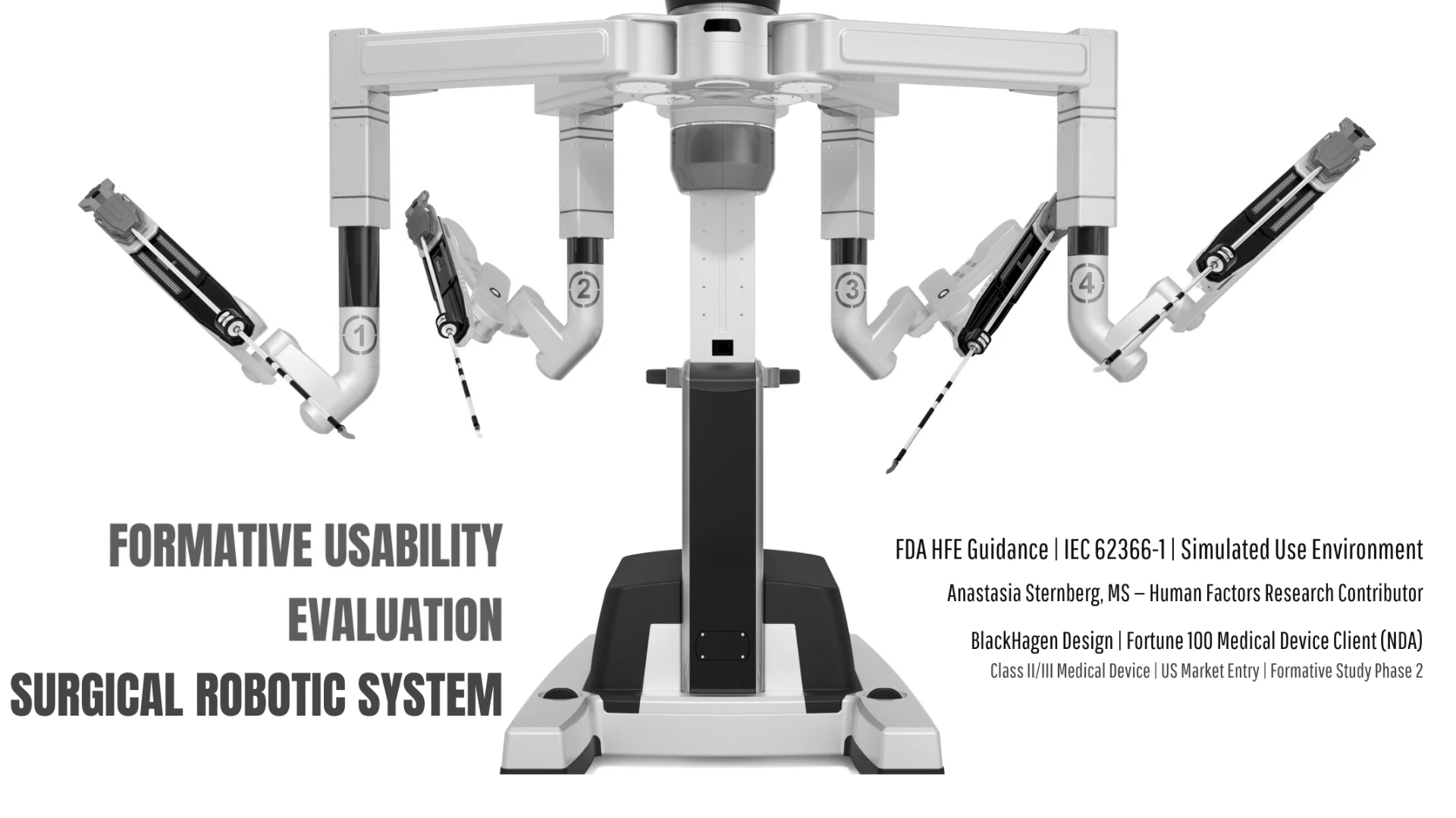
Formative Usability Evaluation, Surgical Robotic System · BlackHagen Design, Fortune 100 medical device client (NDA)

Context. A Fortune 100 medical device company's next-generation surgical robotic system, undergoing formative usability evaluation ahead of FDA clearance for US market entry.

Challenge. Validate that surgical teams could safely operate the device console in high-stress OR environments, with particular risk concentrated in instrument insertion and hand-control calibration, under FDA HFE Guidance and IEC 62366-1.

Solution. Supported a mock-OR usability study with sterile-field fidelity across four surgical roles: surgeon, surgical assistant, circulating nurse, and scrub nurse/tech. Contributed to participant screener development, in-session observation, and initial drafting of the Use-Related Risk Assessment.

Results

  • Captured session data that helped surface 30+ critical use errors across formative phases
  • Majority of identified errors mitigated through design controls before summative validation
  • Observations contributed to a URRA supporting a successful FDA 510(k) submission

Methods & Tools. Think-Aloud Protocol · Task-Based Usability Testing · Use-Related Risk Assessment (URRA) · IFU & Documentation Review

Frameworks. IEC 62366-1 · ISO 14971 · FDA HFE Guidance · FDA 510(k)
Usability for a $1M Medicaid eHR rollout
SMRC2021

Usability for a $1M Medicaid eHR rollout

Conducted research and training with clinicians during a system-wide eHR implementation, informing usability recommendations and risk mitigation.

Brief overview

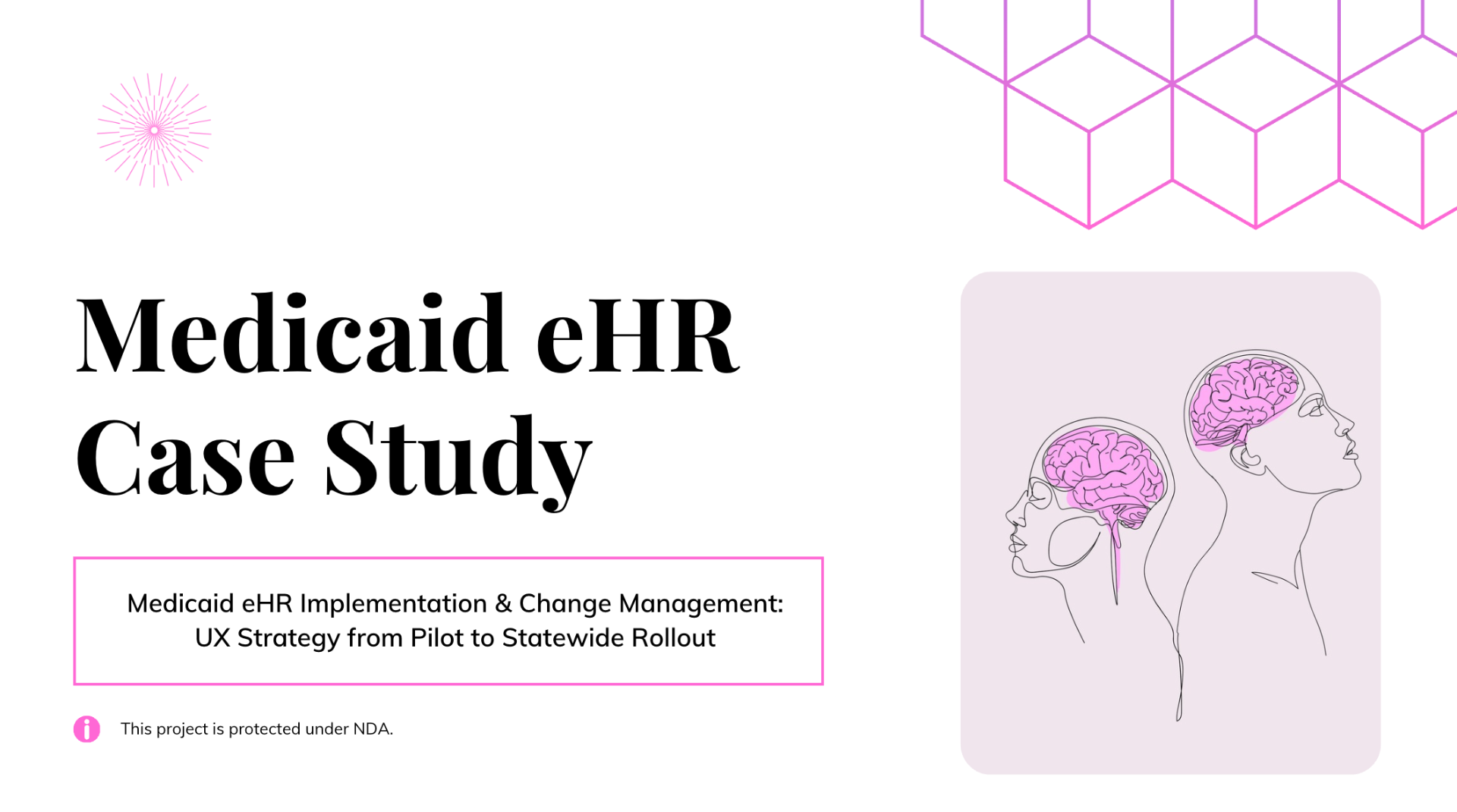
Statewide Medicaid eHR Implementation & Change Management · research initiative within a university social work program

Context. Medicaid agency implementing a new electronic health record system for intellectual/developmental disabilities (IDD) care coordination, including an embedded Level of Care Tool for clinical decision support.

Challenge. A new eHR system launched alongside a major change-management shift from paper-based documentation, increasing cognitive load, disrupting clinician-patient rapport, and introducing new use errors across the statewide rollout.

Solution. Conducted research and training with clinicians during a system-wide eHR implementation for an inter-operational platform between providers and clinicians, informing usability recommendations and risk mitigation.

Results

  • Trained 2,000+ clinicians and administrators across the statewide rollout
  • Capped caseloads at 32 and documentation fields at 20 (down from a proposed 50) based on cognitive-load findings, reducing errors and burnout
  • Recommendations shaped a phased paper-to-tablet transition that increased adoption

Methods & Tools. Ethnography · Contextual Inquiry · Usability Testing · A/B Testing · Focus Groups · Service Blueprint

Frameworks. HIPAA · Medicaid Waiver Compliance · DMH/BIDD Regulatory Requirements

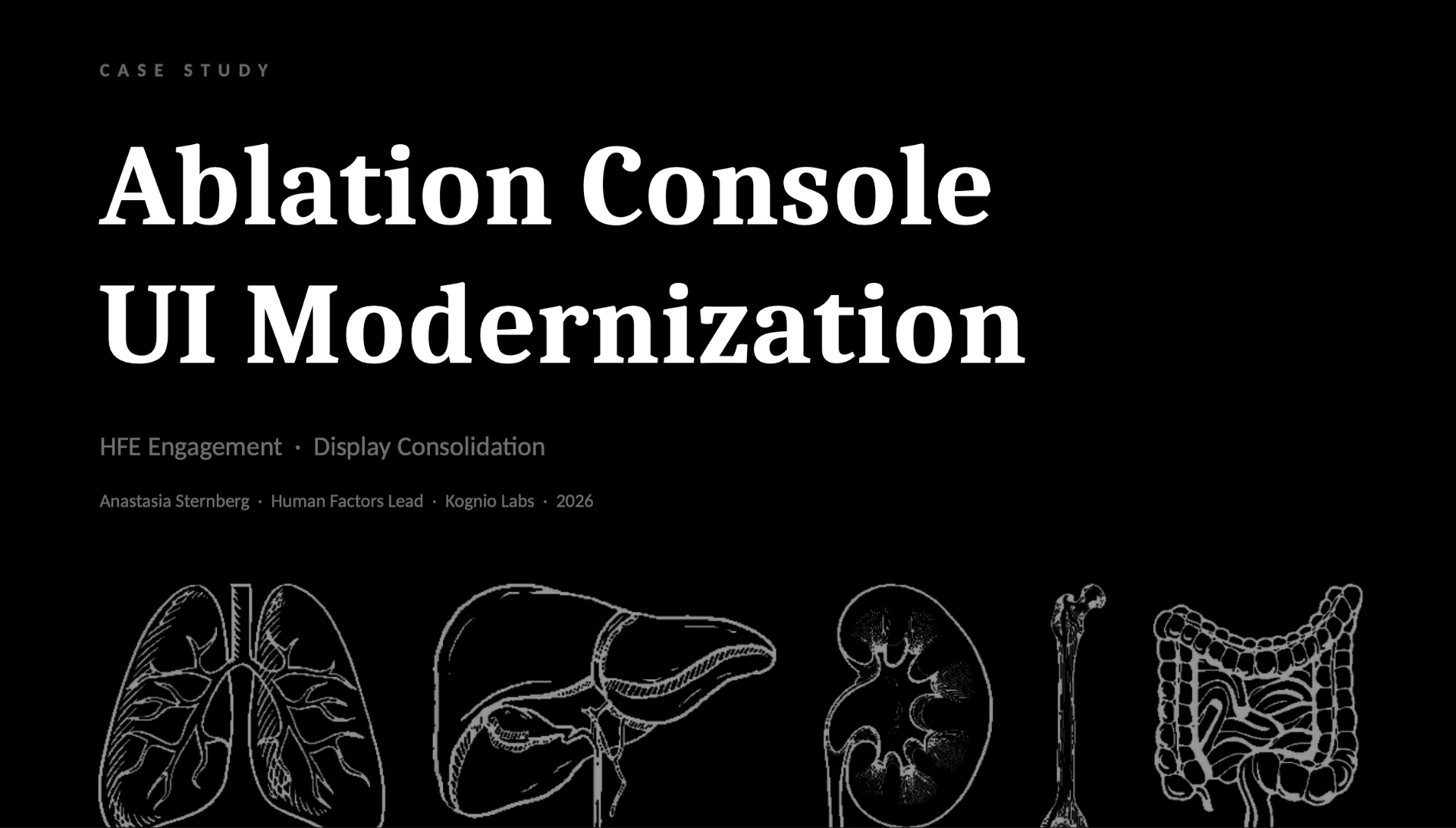
Modernizing an ablation console UI
Kognio Labs2026

Modernizing an ablation console UI

Led HFE design review and delivered options-based direction for a display consolidation on a microwave ablation console, surfacing 9+ UI safety observations, including three safety-critical interaction patterns.

Password protected

Brief overview

Ablation Console UI Modernization · Kognio Labs, Confidential medical device client (NDA)

Context. A medical device company's microwave ablation system for interventional radiology and oncology, undergoing a console UI modernization, consolidating a legacy two-screen, dual-arm configuration into a single consolidated display for use in the IR suite.

Challenge. Identify HFE risk and establish design direction for a display consolidation that could not alter workflow, functionality, or layout, while satisfying IEC 60601-1-8 alarm color constraints and ensuring critical numeric readouts remained legible during active procedures.

Solution. Conducted systematic review of all UI states and hardware photographs, identifying use-error risks across visual hierarchy, alarm system conflicts, distance legibility, and button differentiation. Produced an eight-dimension Design Trend Brief and Ablation Screen Spec Addendum with options-based direction, per-option considerations, and a decision-tracking column.

Results

  • Identified 9+ specific UI safety observations across formative review
  • Identified safety-critical display state conflicts across alarm presentation and error notification
  • Delivered structured options tables across palette, typography, and button system enabling the engineering and design team to evaluate direction against live mockups without blocking design velocity

Methods & Tools. HFE Risk Analysis · UI Heuristic Review · Design Trend Brief · Options-Based Spec Deliverables · IEC 60601-1-8 Alarm Color Compliance Review · Distance Legibility Analysis

Frameworks. IEC 60601-1-8 · AAMI HE75 · FDA HFE Guidance

Scaling EFB research across 200+ airlines
ForeFlight2023

Scaling EFB research across 200+ airlines

Led full-motion flight simulation testing and a cross-regional gap analysis across US, European, and Asia-Pacific airlines, informing feature prioritization on the product roadmap.

Brief overview

FliteDeck ProX · Jeppesen's FliteDeck ProX Electronic Flight Bag, ForeFlight, a Boeing Company

Context. ForeFlight, a Boeing company, building the airline industry's first fully integrated Electronic Flight Bag (EFB), consolidating flight planning, charts, weather, and hazard awareness into a single safety-critical tool.

Challenge. Pilots needed to replace fragmented, paper-based workflows without adding risk in high-workload cockpit environments, all while meeting strict FAA/EASA usability guidelines for the 4.8-to-5.0 feature transition.

Solution. Conducted high-fidelity LOFT simulation testing (real routes, diversions, geographic edge cases), moderated usability sessions using think-aloud, SUS, and NASA TLX, A/B testing of briefing and integration flows, and FAA/EASA heuristic evaluations. Led a gap analysis across 200+ airline operators globally to prioritize the roadmap.

Results

  • Gap analysis across 200 operators spanning 3 continents directly informed feature prioritization
  • Validated designs reduced briefing time and heads-down time for pilots
  • Findings shaped trust-signal requirements for new digital sync features and confirmed the need for manual override on Auto SID/STAR

Methods & Tools. LOFT Simulation Testing · Moderated Usability Testing (SUS, NASA TLX) · A/B Testing · Cognitive Walkthroughs · FAA/EASA Heuristic Evaluation

04Career
  1. 2023 — NowHuman Factors ResearcherKognio Labs
  2. 2022 — 2023UX ResearcherForeFlight
  3. 2021 — 2022Usability SpecialistBlackHagen Design
  4. 2017 — 2019Training CoordinatorUSM
  5. 2012 — 2017, 2020 — 2021Support CoordinatorSMRC
05Recommendations

"Anastasia was extremely professional and thorough — excellent direction and guidance for our team, and an excellent UI design framework. Communication, timing, and delivery all excellent."

Senior Director, Product Development
Surgical Ablation Platform (name withheld per NDA)
Client Engagement · June 2026

"I had the pleasure of working alongside Anastasia for 10 months on a client project where she served as the lead UX researcher. As the principal researcher and designer on the team, I got to see firsthand the depth of her expertise and the energy she brought to the work."

"Anastasia led all facets of the research effort, from recruiting users and conducting interviews, to synthesizing data, coordinating and helping facilitate collaborative workshops, and managing a wide range of stakeholders. She not only brought structure and clarity to a complex research process, but also demonstrated a knack for adjusting course and offering fresh strategies when something wasn't quite working."

"Beyond her research skills, Anastasia built strong rapport with the client through her natural enthusiasm, articulate communication, and thoughtful approach to collaboration, qualities that helped us build trust and ultimately secure buy-in for user research from a client who had historically been hesitant to invest in it."

"I'd highly recommend Anastasia to any team looking for a skilled, strategic, and collaborative UX researcher."

Brian Mila
Design Leader, Enterprise UX & Product Strategy at LexTech Global Services
Project · July 2024–April 2025

Let's talk

Open to full-time roles and select contract engagements across regulated, safety-critical, and complex products.