


Anastasia Sternberg
  • anastasia.uxr@proton.me
  • linkedin.com/in/ana1
  • github.com/Madame-UX
  • kogniolabs.com
Anastasia Sternberg portrait

01 — Introduction

Hi, I'm Anastasia, a dually trained Human Factors Engineer and Senior UX Researcher with 10+ years in safety-critical UX from healthcare to aviation.

02About

I design systems where errors have real-world consequences.

From the cockpit to the operating room, my work is to understand how people behave under complexity, pressure, and constraint, then translate those insights into systems that are reliable, safe, and built for the people actually using them.

I work across regulated domains where usability directly impacts decision-making and operational outcomes: MedTech, aviation, and increasingly, human-AI interfaces where safety-critical thinking has to be embedded into the design itself.

At ForeFlight, a Boeing company, I led research for FliteDeck Pro X, an FAA/EASA-regulated Electronic Flight Bag, conducting flight simulation testing, building research infrastructure, and driving a gap analysis across 200+ airline operators globally that directly informed the product roadmap.

I've also led embedded field research across a statewide Medicaid eHR rollout, training 2,000+ clinicians and informing system-wide design changes based on frontline workflow findings as part of a joint DMH & CMS Medicaid Waiver Initiative.

Through Kognio Labs, I now bring that same rigor to MedTech and product teams building regulated, complex, or safety-sensitive systems, including AI interfaces where interpretability and human judgment alignment aren't optional, and where getting it right requires someone who has seen what happens when it goes wrong.

Professional affiliations

Human Factors and Ergonomics Society (HFES)Association for the Advancement of Medical Instrumentation (AAMI)User Experience Professionals Association (UXPA)

Curriculum vitae

03Selected work

MedTech

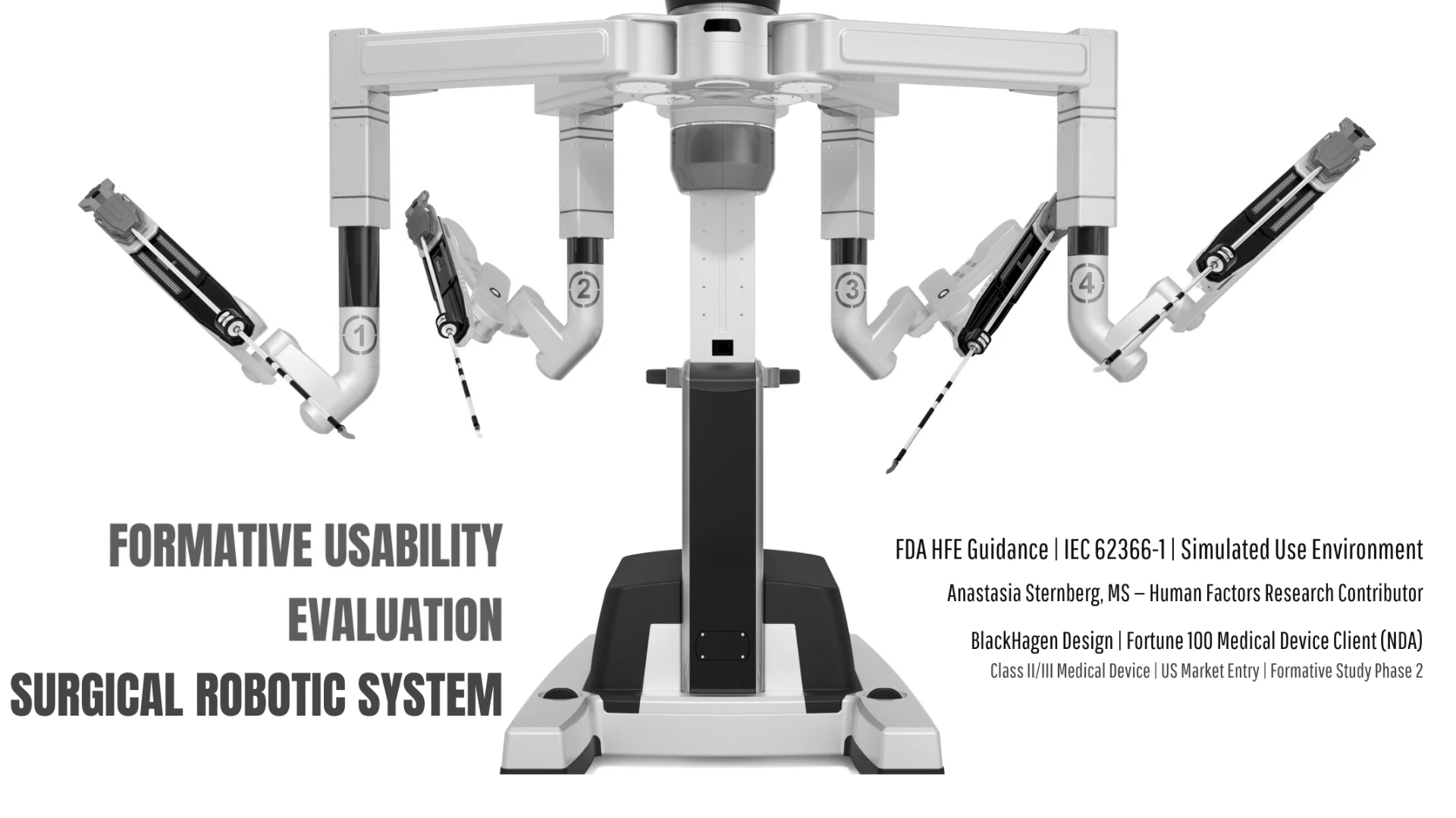
Cutting usability risk in a robotic surgery
BlackHagen Design2022

Cutting usability risk in a robotic surgery

Contributed to formative usability testing for an FDA-regulated robotic surgical device, co-drafting a 200-point URRA that surfaced 30+ critical use errors, 90% mitigated before US market launch.

Brief overview

Formative Usability Evaluation, Surgical Robotic System · BlackHagen Design, Fortune 100 medical device client (NDA)

Context. A Fortune 100 medical device company's next-generation surgical robotic system, undergoing formative usability evaluation ahead of FDA clearance for US market entry.

Challenge. Validate that surgical teams could safely operate the device console in high-stress OR environments, with particular risk concentrated in instrument insertion and hand-control calibration, under FDA HFE Guidance and IEC 62366-1.

Solution. Supported a mock-OR usability study with sterile-field fidelity across four surgical roles: surgeon, surgical assistant, circulating nurse, and scrub nurse/tech. Contributed to participant screener development, in-session observation, and initial drafting of the Use-Related Risk Assessment.

Results

  • Captured session data that helped surface 30+ critical use errors across formative phases
  • Majority of identified errors mitigated through design controls before summative validation
  • Observations contributed to a URRA supporting a successful FDA 510(k) submission

Methods & Tools. Think-Aloud Protocol · Task-Based Usability Testing · Use-Related Risk Assessment (URRA) · IFU & Documentation Review

Frameworks. IEC 62366-1 · ISO 14971 · FDA HFE Guidance · FDA 510(k)
Modernizing an ablation console UI
Kognio Labs2026

Modernizing an ablation console UI

Led HFE design review and delivered options-based direction for a display consolidation on a microwave ablation console, surfacing 9+ UI safety observations, including three safety-critical interaction patterns.

Password protected

Brief overview

Ablation Console UI Modernization · Kognio Labs, Confidential medical device client (NDA)

Context. A medical device company's microwave ablation system for interventional radiology and oncology, undergoing a console UI modernization, consolidating a legacy two-screen, dual-arm configuration into a single consolidated display for use in the IR suite.

Challenge. Identify HFE risk and establish design direction for a display consolidation that could not alter workflow, functionality, or layout, while satisfying IEC 60601-1-8 alarm color constraints and ensuring critical numeric readouts remained legible during active procedures.

Solution. Conducted systematic review of all UI states and hardware photographs, identifying use-error risks across visual hierarchy, alarm system conflicts, distance legibility, and button differentiation. Produced an eight-dimension Design Trend Brief and Ablation Screen Spec Addendum with options-based direction, per-option considerations, and a decision-tracking column.

Results

  • Identified 9+ specific UI safety observations across formative review
  • Identified safety-critical display state conflicts across alarm presentation and error notification
  • Delivered structured options tables across palette, typography, and button system enabling the engineering and design team to evaluate direction against live mockups without blocking design velocity

Methods & Tools. HFE Risk Analysis · UI Heuristic Review · Design Trend Brief · Options-Based Spec Deliverables · IEC 60601-1-8 Alarm Color Compliance Review · Distance Legibility Analysis

Frameworks. IEC 60601-1-8 · AAMI HE75 · FDA HFE Guidance

Healthcare

Usability for a $1M Medicaid eHR rollout
SMRC2021

Usability for a $1M Medicaid eHR rollout

Conducted research and training with clinicians during a system-wide eHR implementation, informing usability recommendations and risk mitigation.

Brief overview

Statewide Medicaid eHR Implementation & Change Management · research initiative within a university social work program

Context. Medicaid agency implementing a new electronic health record system for intellectual/developmental disabilities (IDD) care coordination, including an embedded Level of Care Tool for clinical decision support.

Challenge. A new eHR system launched alongside a major change-management shift from paper-based documentation, increasing cognitive load, disrupting clinician-patient rapport, and introducing new use errors across the statewide rollout.

Solution. Served as embedded field researcher and clinical implementation advisor, running ethnography, contextual inquiry, usability testing, A/B testing, focus groups, and interviews across all four rollout phases. Translated findings into quarterly stakeholder reports and statewide clinician training.

Results

  • Trained 2,000+ clinicians and administrators across the statewide rollout
  • Capped caseloads at 32 and documentation fields at 20 (down from a proposed 50) based on cognitive-load findings, reducing errors and burnout
  • Recommendations shaped a phased paper-to-tablet transition that increased adoption

Methods & Tools. Ethnography · Contextual Inquiry · Usability Testing · A/B Testing · Focus Groups · Service Blueprint

Frameworks. HIPAA · Medicaid Waiver Compliance · DMH/BIDD Regulatory Requirements

AI sales intelligence for biotech SaaS
Kognio Labs2025

AI sales intelligence for biotech SaaS

Led competitive analysis, high-fidelity wireframe design, AI function specification, and heuristic evaluation for an in-call sales coaching platform, surfacing six market gaps and specifying four agentic AI modules grounded in active-call cognitive load.

Password protected

Brief overview

AI Sales Intelligence, Biotech SaaS · Kognio Labs, Confidential client (NDA)

Context. A biotech company developing a SaaS sales coaching platform needed HFE-grounded design and evaluation for a dashboard used by sales representatives during and after client calls. No existing product benchmarks were provided; the engagement ran entirely from client-supplied process videos and whiteboard documentation.

Challenge. User interviews and workflow validation were proposed, scoped, and removed per client decision, leaving cognitive load patterns, information timing under active calls, and task flow assumptions unvalidated.

Solution. Led competitive analysis, user flow reconstruction, high-fidelity wireframe design, AI function specification, and heuristic evaluation across the full product. Benchmarked four direct competitors, identifying six market gaps and specifying four agentic AI modules with interaction constraints grounded in active-call cognitive load.

Results

  • Identified six market gaps across competitors and structured design direction to address each without expanding scope beyond client-approved features
  • Capped AI coach recommendations at three per interaction based on Miller's Law; validated information chunking, radio-button disclosure patterns, and color-as-signal use across all states
  • Delivered design structured for future validation: task flows and AI triggers ready for usability protocol development, with known gaps formally documented

Methods & Tools. Competitive Analysis · User Flow Reconstruction · High-Fidelity Wireframing · AI Function Specification · Heuristic Evaluation · HFE Risk Documentation

Frameworks. Von Restorff Effect · Fitts's Law · Hick's Law · Miller's Law · Gestalt Principles

Aviation

Scaling EFB research across 200+ airlines
ForeFlight2023

Scaling EFB research across 200+ airlines

Led full-motion flight simulation testing and a cross-regional gap analysis across US, European, and Asia-Pacific airlines, informing feature prioritization on the product roadmap.

Brief overview

FliteDeck ProX · Jeppesen's FliteDeck ProX Electronic Flight Bag, ForeFlight, a Boeing Company

Context. ForeFlight, a Boeing company, building the airline industry's first fully integrated Electronic Flight Bag (EFB), consolidating flight planning, charts, weather, and hazard awareness into a single safety-critical tool.

Challenge. Pilots needed to replace fragmented, paper-based workflows without adding risk in high-workload cockpit environments, all while meeting strict FAA/EASA usability guidelines for the 4.8-to-5.0 feature transition.

Solution. Conducted high-fidelity LOFT simulation testing (real routes, diversions, geographic edge cases), moderated usability sessions using think-aloud, SUS, and NASA TLX, A/B testing of briefing and integration flows, and FAA/EASA heuristic evaluations. Led a gap analysis across 200+ airline operators globally to prioritize the roadmap.

Results

  • Gap analysis across 200 operators spanning 3 continents directly informed feature prioritization
  • Validated designs reduced briefing time and heads-down time for pilots
  • Findings shaped trust-signal requirements for new digital sync features and confirmed the need for manual override on Auto SID/STAR

Methods & Tools. LOFT Simulation Testing · Moderated Usability Testing (SUS, NASA TLX) · A/B Testing · Cognitive Walkthroughs · FAA/EASA Heuristic Evaluation

Reducing cognitive load and flight delays
LexTech Global Services2025

Reducing cognitive load and flight delays

Investigated how cognitive overload in flight crews contributes to operational delays, translating findings into actionable design and workflow recommendations.

Password protected

Brief overview

No Delay · Redesigning a legacy pilot operations platform, major global airline carrier

Context. One of the world's largest airline carriers, running a 40-year-old legacy platform for pilot and ground-support operations.

Challenge. An 18-section navigation structure buried critical pre-flight and post-flight information behind layers of submenus. With every piece of operational content living in the same surface, pilots and support staff faced severe information overload when they needed answers in seconds, not minutes.

Solution. Led a 10-month research engagement, 40+ interviews, live card sorting, contextual inquiry with duty pilots in ground control, and iterative testing across web and mobile, to restructure the platform's information architecture from the ground up.

Results

  • Restructured IA from 18 navigation categories down to 5
  • 1,000+ pieces of content tagged and organized into a working hierarchy
  • Findings directly informed the platform's CMS relaunch and handoff content templates

Methods & Tools. Contextual Inquiry · Card Sorting · Journey Mapping · Service Blueprint · Personas · Jobs-to-be-Done · A/B Testing · Aurelius · Dovetail · Airtable

04Methods & skills

Research methods

Contextual inquiry, usability testing (formative & summative), heuristic evaluation, task-based analysis, root-cause analysis, concept validation testing, simulation lab testing, card sorting, journey mapping, service blueprints, stakeholder workshops.

Regulatory fluency

  • FDA guidance
  • IEC 62366-1/2
  • ISO 13485
  • ISO 14971
  • ISO 9241-220
  • HE 75

Products

  • Enterprise SaaS: B2B
  • Enterprise SaaS: B2B2C
  • Medical Device Software (SaMD)
  • Clinical EHR Platforms
  • Aviation Avionics / EFB

Tools

LookbackFigmaDovetailCondensOptimal WorkshopAirtableSurveyMonkeyClaudeCoworkLovable
05Career
  1. 2023 — NowFounder & Principal ConsultantKognio Labs
  2. 2022 — 2023UX & Human Factors ResearcherForeFlight
  3. 2021 — 2022Usability SpecialistBlackHagen Design
  4. 2017 — 2019Training CoordinatorUSM
  5. 2012 — 2017, 2020 — 2021Support Coordinator & eHR AdvisorSMRC
06Recommendations

"I had the pleasure of working alongside Anastasia for 10 months on a client project where she served as the lead UX researcher. As the principal researcher and designer on the team, I got to see firsthand the depth of her expertise and the energy she brought to the work."

"Anastasia led all facets of the research effort — from recruiting users and conducting interviews, to synthesizing data, coordinating and helping facilitate collaborative workshops, and managing a wide range of stakeholders. She not only brought structure and clarity to a complex research process, but also demonstrated a knack for adjusting course and offering fresh strategies when something wasn't quite working. Her adaptability and problem-solving mindset were major assets."

"Beyond her research skills, Anastasia built strong rapport with the client through her natural enthusiasm, articulate communication, and thoughtful approach to collaboration — qualities that helped us build trust and ultimately secure buy-in for user research from a client who had historically been hesitant to invest in it. Thanks in large part to her efforts, we were able to demonstrate the value of research in shaping the direction of the project."

"I'd highly recommend Anastasia to any team looking for a skilled, strategic, and collaborative UX researcher."

Brian Mila
Design Leader, Enterprise UX & Product Strategy at LexTech Global Services
Worked with Anastasia · April 2025

07 — Let's talk

I'm currently exploring work in MedTech, healthcare, and other regulated or high-stakes product spaces.

If that overlaps with what you're building, I'd love to talk.